Let us be honest Edge Computing sounds like one of those phrases that people use in technology meetings to sound impressive.. The truth is, it is actually one of the most practical changes happening in technology right now and it is probably already affecting your life without you even realizing it.
So what is Edge Computing really?. Why should you care about Edge Computing? Let us break it down with some real Edge Computing examples that show how Edge Computing works in the real world not just on a whiteboard.
What Is Edge Computing Anyway?
The simplest way to think about Edge Computing is this. Normally when a device collects data like a sensor on a factory machine that data travels all the way to a server somewhere far away gets processed and then a response travels all the way back. That round trip takes time sometimes a second or two but in many situations even a second is too long.
Edge Computing changes this process. Of sending data off to a distant data center the processing happens right where the data is created on the device itself or on a small server nearby. No long commute for your data quick local decision-making with Edge Computing.
That might sound like a change but it changes everything for industries that depend on speed and use Edge Computing.
Why These Edge Computing Examples Actually Matter
It is easy to nod along when someone explains a concept like Edge Computing. The real value shows up when you see Edge Computing in action. That is why looking at Edge Computing examples across healthcare, manufacturing, retail, transportation and more tells a much more convincing story than any definition could about Edge Computing.
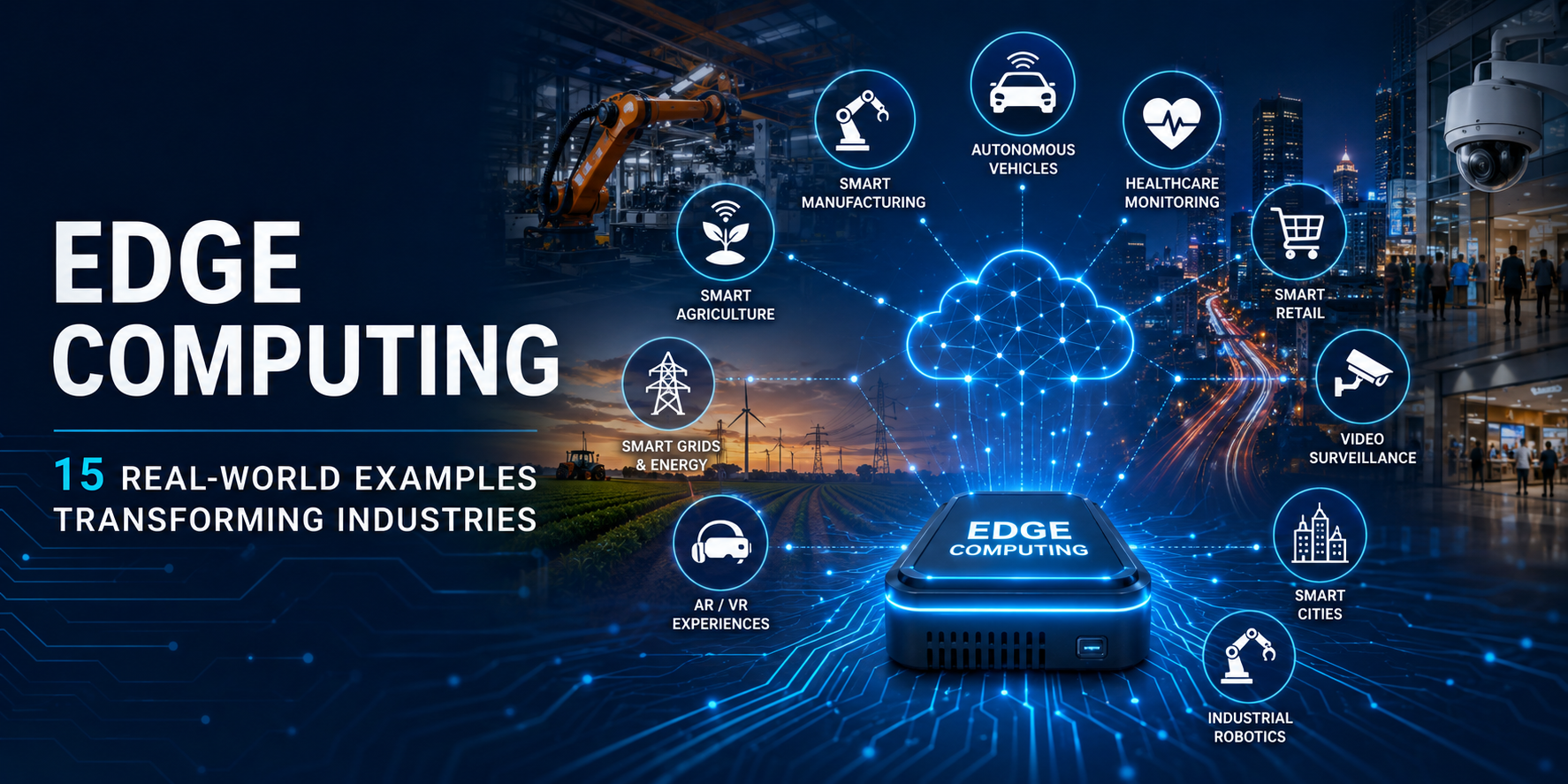
Below are 15 examples that show Edge Computing is not just theoretical it is already running in the background of industries you interact with every day and using Edge Computing.
15 Real-World Edge Computing Examples
1. Smart Manufacturing and Predictive Maintenance
Imagine a factory floor with hundreds of machines running. If one starts vibrating a little or heating up just slightly more than usual that could be the first sign of trouble. With Edge Computing sensors catch that anomaly instantly and flag it on the spot no waiting around for a server to crunch the numbers and report back with Edge Computing. That speed can mean the difference between a fix and a costly shutdown with Edge Computing.
2. Autonomous Vehicles
This one is probably the example people picture first. Self-driving cars are constantly drinking in data from cameras, radar and lidar. They need to react in milliseconds, not seconds. There is simply no time to send that data to the cloud and wait for instructions with Edge Computing. So the car processes everything itself there in the moment, which is exactly why Edge Computing is non-negotiable for autonomous driving and uses Edge Computing.
3. Healthcare Monitoring Devices
Hospitals and wearable health tech rely on this idea of Edge Computing. A heart monitor that is tracking a patients vitals cannot afford to wait on a round-trip if something goes wrong with Edge Computing. Processing locally with Edge Computing means alerts go out immediately which honestly can be the difference between catching a problem and missing it altogether with Edge Computing.
4. Smart Retail and In-Store Analytics
Ever notice how some stores seem to know when shelves are running low or catch theft almost instantly through camera systems with Edge Computing? That is Edge Computing working behind the scenes analyzing footage and sensor data in the store instead of routing it through some far-off server first with Edge Computing.
5. Smart Grids and Energy Management
Power companies are using Edge Computing devices throughout the grid to watch for outages, balance loads and react to spikes in demand with Edge Computing. With renewable energy sources entering the mix this kind of real-time monitoring is not a nice-to-have anymore it is pretty much essential for keeping the lights on with Edge Computing.
6. Connected Agriculture (Smart Farming)
Out in the middle of a field you are not always going to have an internet connection. That is where Edge Computing genuinely shines with Edge Computing. Sensors scattered across farmland can track soil moisture and weather conditions. Give farmers instant insights even when connectivity is spotty at best with Edge Computing.
7. Industrial IoT in Oil and Gas
Drilling sites and pipelines are often in hard-to-reach places where internet access is unreliable to put it generously. Edge Computing lets safety systems and operational monitoring keep functioning with Edge Computing so a weak signal does not turn into a safety risk with Edge Computing.
8. Smart Cities and Traffic Management
Anyone who has sat through a red light knows how frustrating bad traffic management can be. Cities are now using Edge Computing-enabled sensors and cameras at intersections to adjust timing on the fly based on actual real-time traffic, not some outdated schedule with Edge Computing.
9. Augmented and Virtual Reality
If you have ever felt that lag or nausea in a VR headset that is latency ruining the experience with Edge Computing. Edge Computing helps process data closer to the user with Edge Computing, which keeps things smooth and immersive whether it is gaming training simulations or remote collaboration tools with Edge Computing.
10. Video Surveillance and Security Systems
Modern security cameras do not just record anymore many of them analyze footage on the device with Edge Computing spotting unusual activity or recognizing faces without streaming everything to the cloud with Edge Computing. It is faster. It cuts down on bandwidth costs too with Edge Computing.
11. Telecommunications and 5G Networks
5G and Edge Computing kind of go hand in hand. Telecom companies are placing Edge Computing servers to users so that bandwidth-heavy stuff like streaming, gaming and video calls actually run the way they are supposed to without annoying buffering or lag with Edge Computing.
12. Retail Supply Chain and Logistics
Warehouses are chaotic places and Edge Computing helps keep them running smoothly with Edge Computing. Inventory tracking, robotic systems and logistics planning all benefit from processing with Edge Computing, which means fewer delays and fewer mistakes with Edge Computing.
13. Smart Home Devices
This is probably the overlooked example on this list simply because it is so normal now. Your smart speaker, thermostat or doorbell camera is likely processing a chunk of data locally than sending everything to the cloud partly for speed and partly to protect your privacy with Edge Computing.
14. Banking and Financial Services
Fraud detection has to happen especially at ATMs and point-of-sale terminals with Edge Computing. Edge Computing allows banks to flag transactions the moment they happen rather than after the damage is already done with Edge Computing.
15. Remote Industrial Robotics
In factories and warehouses where robots work alongside people split-second decisions matter for safety with Edge Computing. Edge Computing lets these robots process what they are sensing in time instead of relying on a cloud connection that could lag at exactly the wrong moment with Edge Computing.
What These Edge Computing Examples Have in Common
Looking at all 15 of these a pretty obvious pattern starts to show up. The industries getting the value from Edge Computing are the ones where waiting just is not an option, where a delay of even a second or two could mean a missed opportunity, a safety risk or a costly mistake with Edge Computing.
Speed Is the Point
Nearly every example above comes back to one thing: latency with Edge Computing. Processing data close to where it’s created means decisions happen almost instantly instead of being held up by a trip to a faraway server with Edge Computing.
It Also Saves Money
There is an angle too with Edge Computing. Sending streams of raw data to the cloud is not cheap with Edge Computing. Edge Computing devices. Process information locally sending only the important bits, which keeps bandwidth costs down with Edge Computing.
And It Keeps Things Running Where the Internet Does Not Reach
Whether it is a farm in the middle of nowhere or an oil rig out at sea Edge Computing means operations do not grind to a halt just because the Wi-Fi is unreliable with Edge Computing.
Final Thoughts
Looking at these Edge Computing examples side by side it is clear this is not a buzzword that will fade out in a year or two with Edge Computing. It is quietly becoming the backbone of how a lot of industries function, healthcare, retail, transportation you name it. Using Edge Computing.
As more devices come online and the amount of data we generate keeps climbing Edge Computing is only going to become more important with Edge Computing. If your business has not looked into how this could fit into your operations yet it might be worth a closer look sooner rather than later, with Edge Computing.